Core workflows
Plan. Teach. Log. Record.
Binder works best when it follows the natural rhythm of homeschool life rather than trying to turn your home into an institution. These four steps — plan, teach, log, record — are the backbone of how most Binder families use the app.
Workflow screenshots
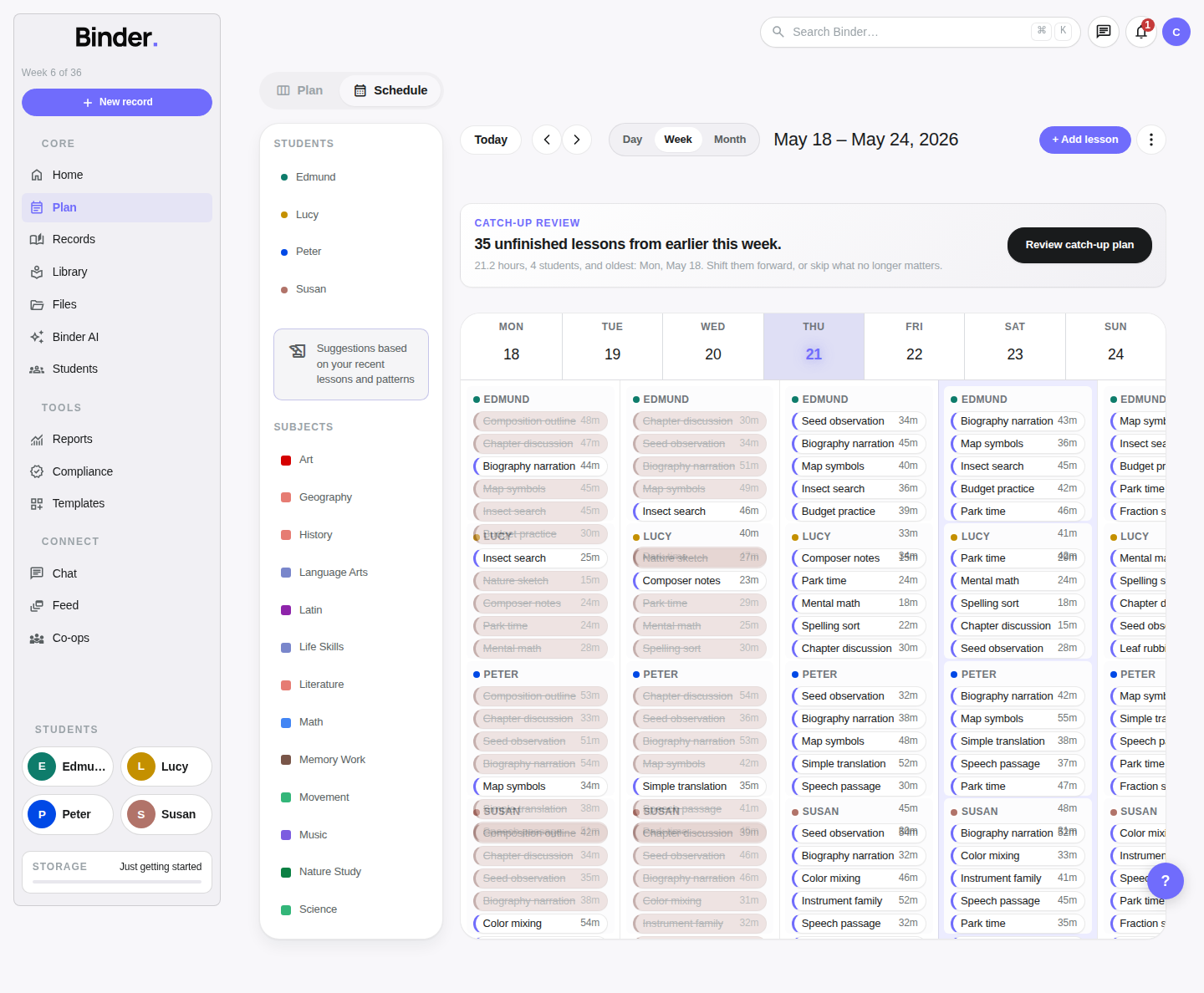
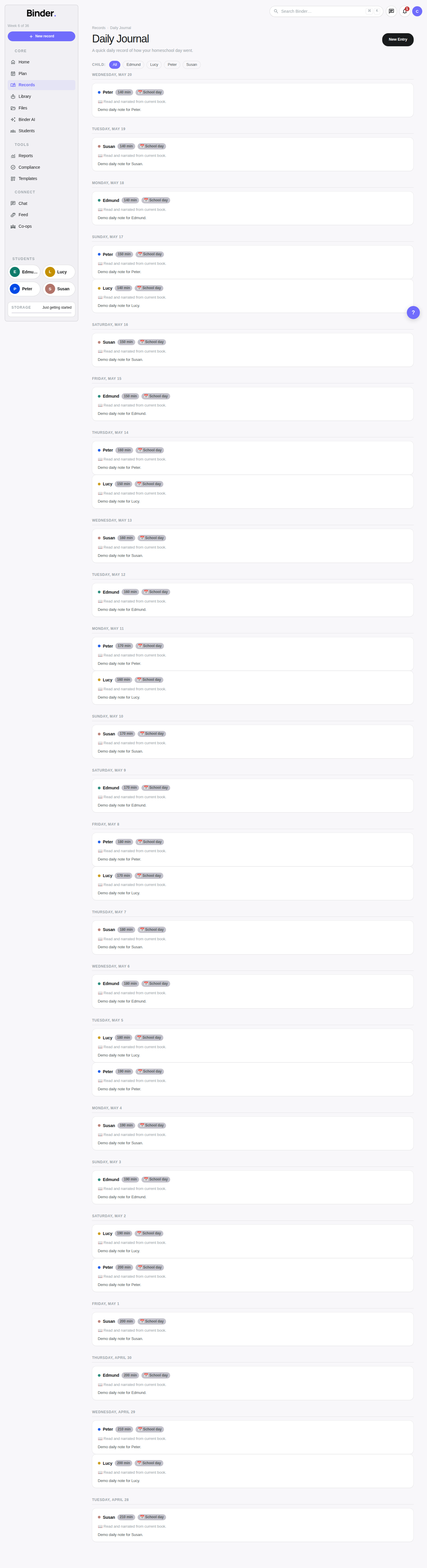
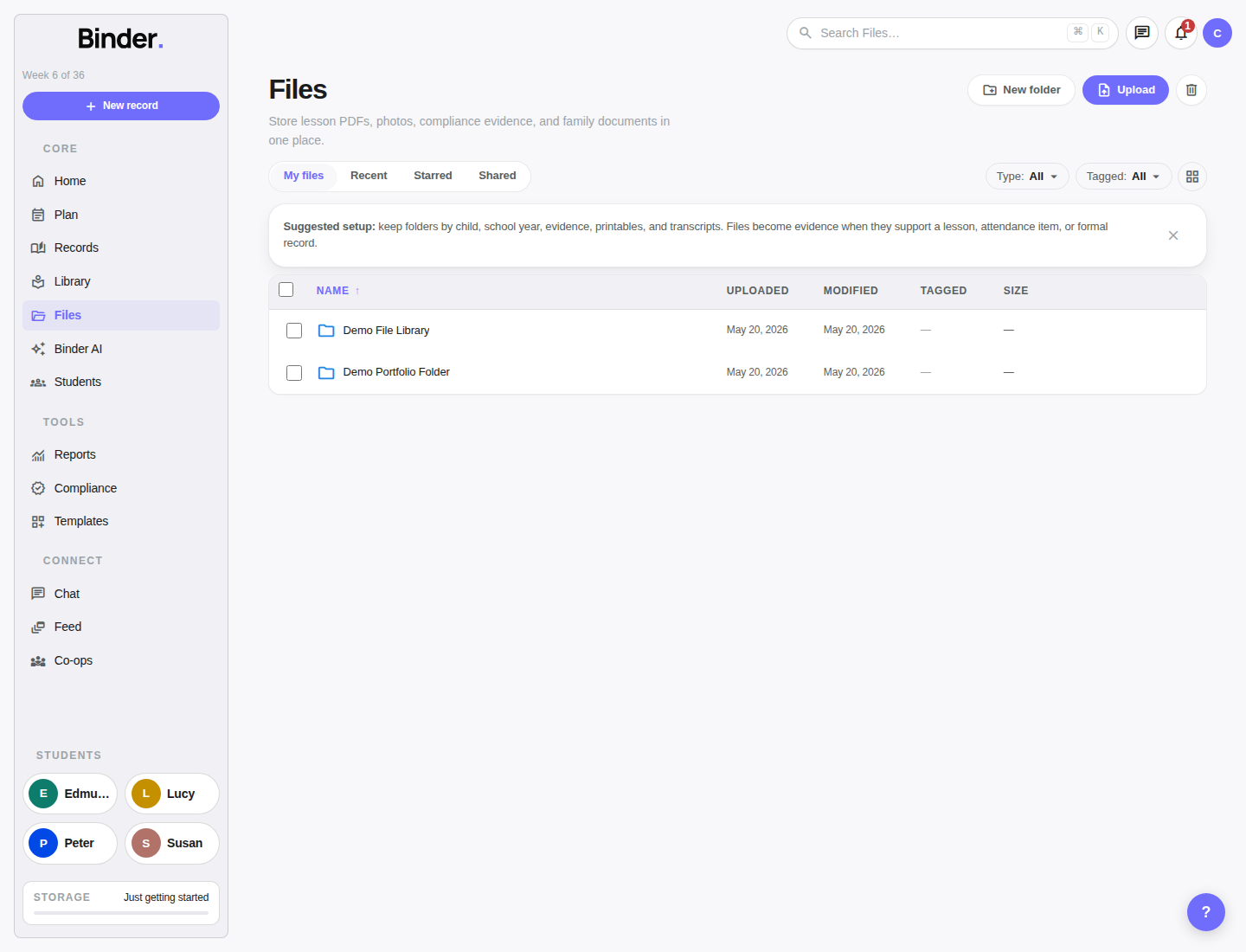
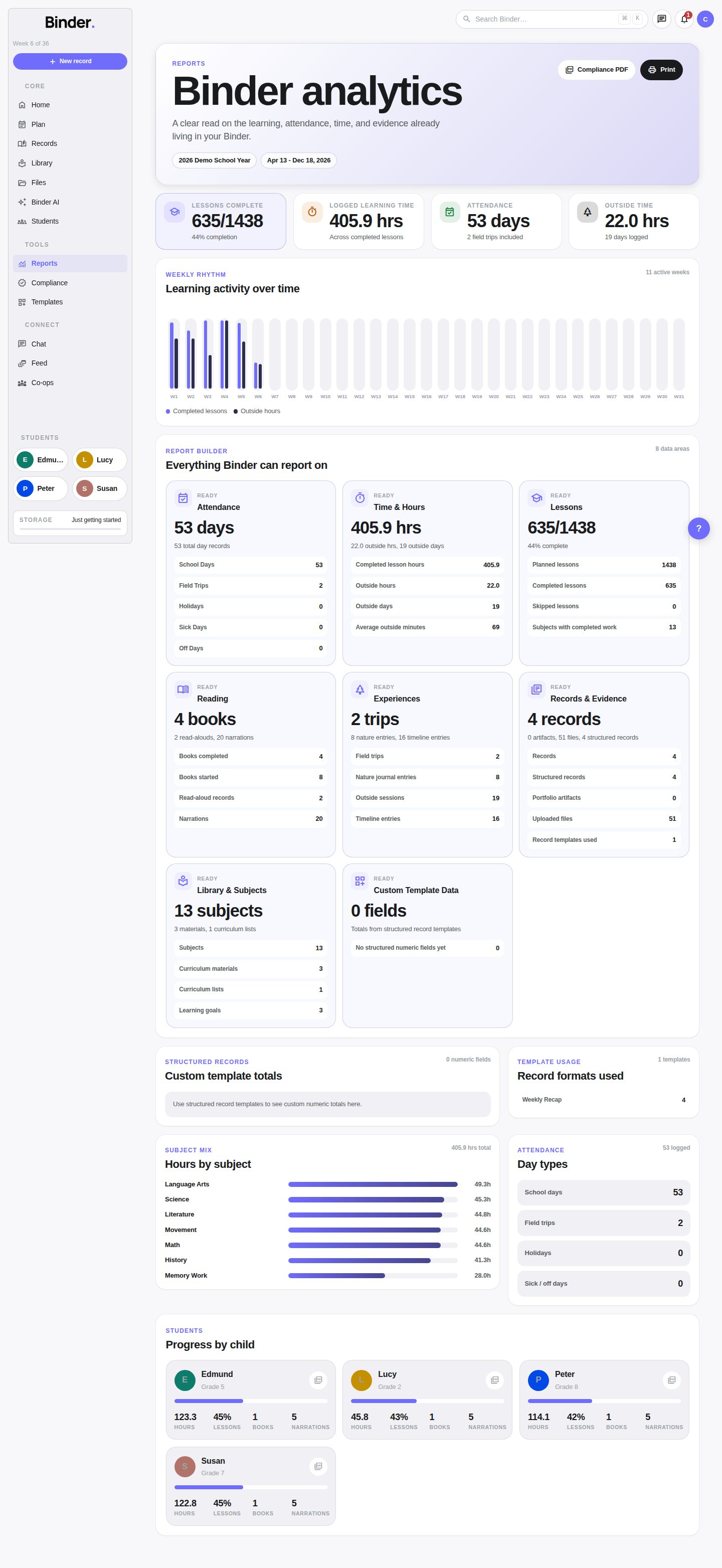
A normal Binder week moves from planning to logging, then into evidence, reports, and records.
The daily rhythm
The most effective Binder rhythm is simple and sustainable. Most families settle into something like this:
Sunday evening: Plan the week
Open the week planner. Draft lessons for each child. Copy what repeats from last week. Adjust for the real week ahead — appointments, co-op days, field trips. Don't over-plan. Binder can hold a lot; you don't need to fill every slot.
During the day: Teach
Use the plan as a guide, not a cage. The planner is visible on mobile so you can reference it during the day. If a lesson runs long or gets skipped, don't worry — adjust, move, or skip. Binder won't penalize you for a plan that reflects real life.
End of day: Log
After teaching, spend five minutes marking lessons complete, writing a quick daily journal entry, and logging any narrations, books, or habits that happened. This is how lessons become records. Don't skip this — the portfolio and compliance reports are built from these daily completions.
Term end: Review and record
At the end of each term, review what was completed, generate a progress report, finalize attendance, and write a portfolio record or annual narrative using Binder's record templates. Export what you need for evaluators, your state, or your own archive.
Weekly planning workflow
The week planner at Plan → Planner is your primary planning surface. Here's how most families approach the weekly planning session:
- Start with what repeats. If your family did the same math curriculum chapter every Monday last week, copy that forward. On Plus and Scholar plans, use Copy Week to duplicate the entire last week in one click. On Free, create recurring lessons manually; Plus unlocks bulk copy and automation.
- Add one-off lessons. Field trip this Wednesday? Insert a field trip lesson and also log it in Field Trips. Guest speaker? Add it. Don't be afraid to have more lessons than you'll complete — the incomplete ones are just skipped, not penalized.
- Check your compliance coverage. If your state requires a minimum of hours in specific subjects, glance at the Compliance Profile before closing the planner. Are you light on Science this week? Add a nature journal session or a lab lesson.
- Consider your children individually. The planner shows each child's column side by side. Make sure each child is appropriately planned — the younger child might have fewer lessons, or one child might be working through a project week.
Daily logging
Logging is the act of turning a plan into a record. It's the step most families underestimate — the plan alone proves nothing; it's the completion log that creates the legal and portfolio record of what was actually taught.
A thorough daily log takes about five minutes. Here's what to capture:
Mark lessons complete
Check off each lesson you taught today. This records completion time, adds to subject hour totals, and counts the day as a school day. It's the single most important daily action in Binder.
Write daily journal entries
For each child, write a brief journal entry describing the day. Even two or three sentences captures the texture of the day and builds a living record that lesson check-offs alone can't. Over a year, these become a beautiful narrative of your child's education.
Log narrations, books, habits
If a child narrated after reading, log it. If they finished a chapter book, mark it in the book list. If you did habit practice, check off the habit. These don't take much time individually and they dramatically enrich the portfolio.
Capture field trips and special days
If today was a field trip or unusual educational event, log it in Field Trips. This creates a permanent record with date, location, and context — exactly what's needed for compliance or an annual portfolio review.
Binder's dashboard shows you which children have incomplete lessons today and which haven't had a journal entry yet, making it easy to see at a glance what still needs to be logged before you close the day.
Capturing evidence
Evidence — also called artifacts — is any file you attach as proof of a lesson, narration, project, or activity. Evidence is optional but powerful: it transforms a completion check into a verifiable record. A portfolio with evidence is much stronger than a log alone when it comes to evaluations and state reviews.
What counts as evidence
- A photo of a completed worksheet
- A scan of handwritten copywork or narration
- A video of an oral narration or presentation
- A PDF of a completed test or essay
- A photo from a field trip or nature journal session
- A recording of a musical performance or memorized poem
Attaching evidence
Open any lesson, narration, daily log, field trip, nature entry, memory work piece, copywork entry, or read-aloud. Click Attach Evidence and upload the file. Binder accepts PDF, image, video, audio, and document files up to 100 MB per file.
Evidence coverage
Each child's profile page shows an evidence coverage percentage — the share of completed lessons that have at least one artifact attached. Aim for 30–50% coverage for a well-documented portfolio. You don't need evidence for every lesson, but the lessons that matter should have it.
Evidence gallery
All evidence across all children is visible in the unified Artifacts gallery at Records → Evidence. Filter by child, subject, term, or evidence type. Bulk export everything as a ZIP archive (Scholar plan) for offline backup or to hand to an evaluator.
End-of-term review
At the end of each term — whether that's a semester, a full school year, or a custom block — Binder gives you everything you need to close out the year cleanly and prepare for what's next.
Review and finalize attendance
Open the Attendance calendar and verify each day. Adjust any days that were logged incorrectly. Binder shows your final school day count against your attendance goal and your state's requirement.
Generate your progress report
Go to Formal Records → Reports. Generate a term progress report showing all lessons completed, total hours by subject, attendance days, books read, and narrations logged. On Plus and Scholar plans, export this as a formatted compliance PDF ready for evaluators or state records.
Write a portfolio record
Go to Records → New Record. Choose a record template (like "Annual Narrative" or "Portfolio Summary"). Binder auto-populates the template with real data from your term — lessons, hours, books, narrations, subjects. Edit and personalize the draft, then save it to the portfolio.
Duplicate the term for next year
Go to Formal Records → Terms. Use Duplicate on the completed term to create a fresh term for next year. The structure (subjects, templates) carries over; the lessons and logs do not. You're ready to start planning the new year immediately.