Beginner education
Homeschool styles, without the jargon.
You do not need to pick a perfect philosophy before you start. A homeschool style is simply a default way to organize learning: how much structure you want, what counts as progress, how you use books and projects, and how you keep records. Binder supports all of them, including a mixed approach.
Start here: structure vs. freedom
Most homeschool styles sit somewhere between highly structured school-at-home and highly flexible child-led learning. Neither end is automatically better. The best choice is the one your parent capacity, child temperament, state requirements, and family rhythm can actually sustain.
More structure
Traditional, online school, and some classical approaches give you a clear schedule, subject list, assignments, and measurable progress. They reduce decision fatigue but can feel rigid.
Balanced structure
Charlotte Mason, unit studies, Montessori-inspired, Waldorf-inspired, and eclectic approaches provide a rhythm while leaving room for interest, projects, and family culture.
More freedom
Unschooling and interest-led approaches begin with curiosity and real life. They can be deeply effective, but they need intentional observation and good records so learning remains visible.
How to choose your starting style
Choose a starting point by answering practical questions. You can change later; many families do.
If you need confidence quickly
Start with Traditional, Classical, or Online/Hybrid. These approaches give you visible lesson plans and clear “we did school today” signals.
If your child loves stories and conversation
Look at Charlotte Mason or Unit Studies. These styles center books, discussion, narration, hands-on work, and a broad feast of ideas.
If your child learns by doing
Look at Montessori-inspired, Waldorf-inspired, Unit Studies, or Project-Based learning. These emphasize materials, making, movement, art, nature, and lived experience.
If school has been a bad fit
Consider Eclectic or Unschooling, especially after a transition period. You can rebuild trust, observe what motivates your child, and add structure gradually.
A good first decision
Pick one primary style for the next six weeks, not forever. In Binder, set that as your method, build a simple week, and let your records show what is working before you overhaul everything.
Major homeschool styles
Use these summaries to understand the feel of each approach, not as rigid definitions.
Traditional / school-at-home
Core idea: Recreate a familiar school structure at home: subjects, textbooks, assignments, tests, grades, and attendance.
Good fit when: You want a clear plan, your state requires formal records, or your child prefers predictable expectations.
Watch out for: Trying to run a six-hour classroom with one or two children. Homeschool often takes less direct instruction time.
Binder setup: Create subjects, schedule lessons in the planner, mark attendance, attach assessments as files, and use reports/transcripts for formal records.
Classical
Core idea: Build knowledge through language, memory, logic, discussion, great books, history, and rhetoric. Many families use the grammar, logic, and rhetoric stages as a rough developmental map.
Good fit when: You value history, literature, memorization, Latin or language study, and a rigorous academic path.
Watch out for: Overloading memory work or pushing abstract logic too early. Keep the child's age and capacity in view.
Binder setup: Use Memory Work for facts and passages, Timeline for history, Planner for subjects, Books for reading, and Transcripts for high school.
Charlotte Mason
Core idea: Children are whole persons. Education should offer living books, narration, nature study, habit formation, art, music, poetry, and short focused lessons.
Good fit when: Your family likes reading aloud, conversation, nature, beauty, and gentle but serious academics.
Watch out for: Treating “gentle” as “unplanned.” The method works best with steady habits and a rich book list.
Binder setup: Use Narrations, Read-Alouds, Nature Study, Copywork, Habits, Cultural Studies, Books, and Daily Logs.
Montessori-inspired
Core idea: Children learn through prepared environments, hands-on materials, independence, observation, and developmentally appropriate work.
Good fit when: Your child likes practical tasks, movement, manipulation, choice, and self-paced repetition.
Watch out for: Buying too many materials without a clear environment or observation habit.
Binder setup: Use Daily Logs for observations, Files for photos and work samples, Trackers for skill progression, and Records for periodic reviews.
Waldorf-inspired
Core idea: Learning follows developmental stages and seasonal rhythms, blending story, art, movement, handwork, nature, and main lesson blocks.
Good fit when: Your family values rhythm, story, beauty, handwork, outdoor life, and fewer fragmented subjects in a day.
Watch out for: Making the aesthetic so elaborate that planning becomes exhausting.
Binder setup: Use Planner for main lesson blocks, Daily Logs for rhythm notes, Files for main lesson book photos, Nature Study, Cultural Studies, and Field Trips.
Unit studies
Core idea: Organize learning around a theme: oceans, Ancient Egypt, space, gardening, the American Revolution. Reading, writing, science, art, history, and field trips connect to the topic.
Good fit when: You teach multiple ages together or your child learns well through immersion and projects.
Watch out for: Losing skill progression in math, writing, or reading. Keep a few core skills moving alongside the unit.
Binder setup: Create a subject or tag-like naming pattern for the unit, schedule lessons, attach project evidence, log field trips, and write a unit-end Record.
Unschooling / interest-led
Core idea: Learning grows from the child's curiosity, real life, relationships, questions, projects, work, play, and conversation rather than a fixed curriculum.
Good fit when: Your child is self-motivated, needs recovery from a bad school experience, or learns intensely through interests.
Watch out for: Confusing freedom with absence. The parent still observes, supports, documents, and expands opportunity.
Binder setup: Use Daily Logs heavily, plus Books, Field Trips, Files, Records, and broad subjects to map real learning back to state categories.
Eclectic
Core idea: Mix the tools that work: traditional math, Charlotte Mason literature, unit-study science, online language, co-op art, and interest-led projects.
Good fit when: Your children have different needs or you already know one philosophy will not cover everything.
Watch out for: Constant switching. Give a resource enough time to prove whether it works before replacing it.
Binder setup: Use Planner for structured subjects, Daily Logs for flexible work, Files for evidence, and Reports to see whether the mix is balanced.
Online / hybrid / co-op supported
Core idea: Combine home education with online classes, tutoring, charter support, co-op classes, or part-time outside instruction.
Good fit when: You want outside teaching support, accountability, advanced classes, social structure, or help with a subject you do not want to teach yourself.
Watch out for: Too many outside commitments. A full online course load plus homeschool extras can become heavier than expected.
Binder setup: Use Subjects and Planner for outside classes, Files for syllabi and assignments, and Records for what happened outside Binder.
What a day can look like
These are examples, not rules. The point is to understand the rhythm each style tends to create.
Traditional day
Math lesson, language arts, history reading, science assignment, lunch, independent reading, then check work and mark attendance.
Charlotte Mason day
Short math lesson, living book reading, narration, copywork, nature walk, poetry, read-aloud, and a brief daily log.
Unit study day
Read about the topic, map it, write a paragraph, do an experiment or project, attach photos, then log the covered subjects.
Montessori-inspired day
Prepared work choices, observation, practical life task, material practice, read-aloud, outdoor time, and parent notes.
Unschooling day
Child follows a deep interest, parent supports with resources and conversation, then records learning afterward in a daily log.
Eclectic day
Structured math, living book history, online Spanish, project work, co-op prep, and an end-of-day record tying it together.
Setting up Binder by style
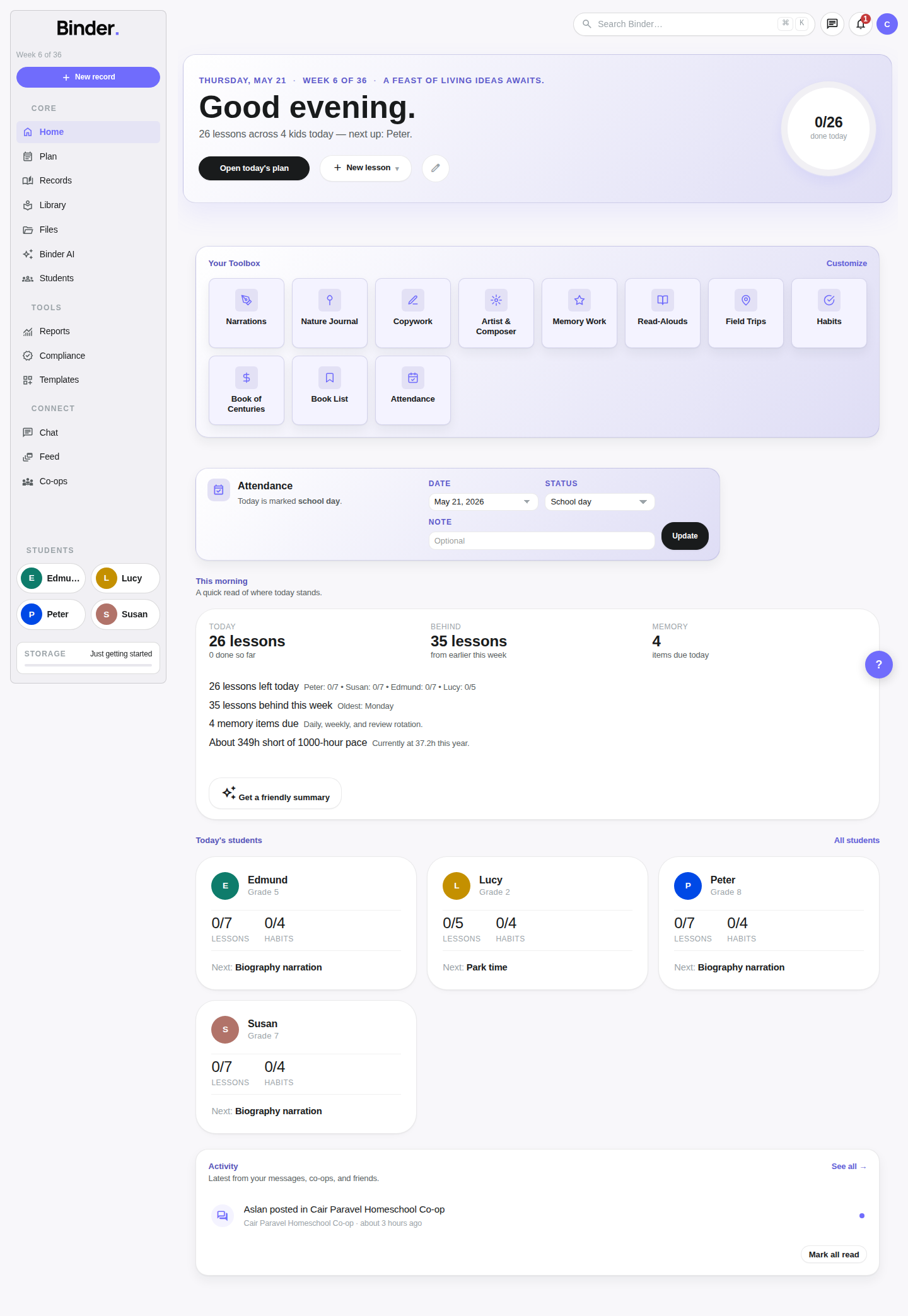
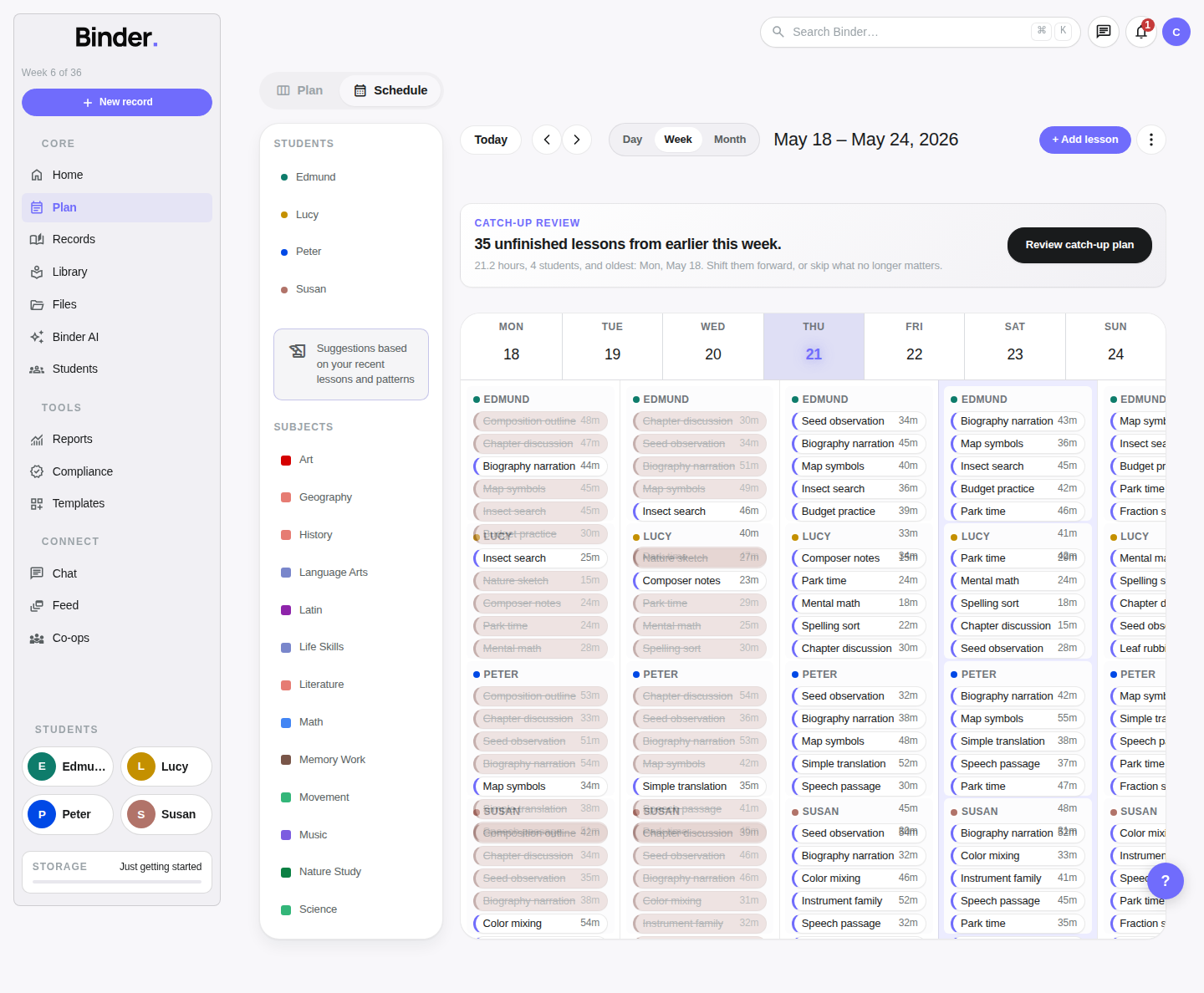
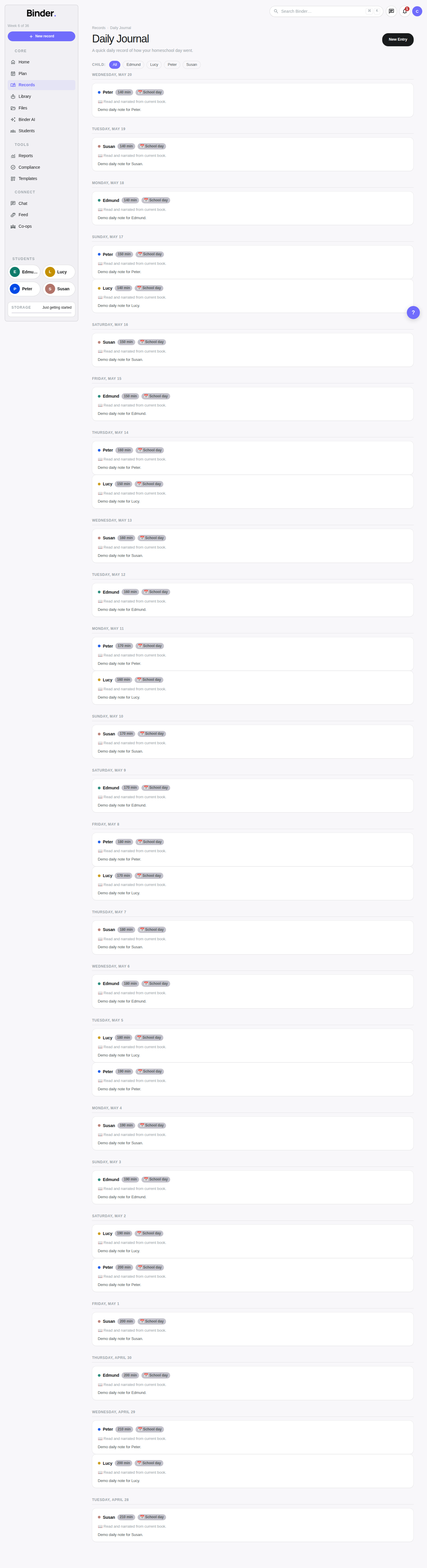
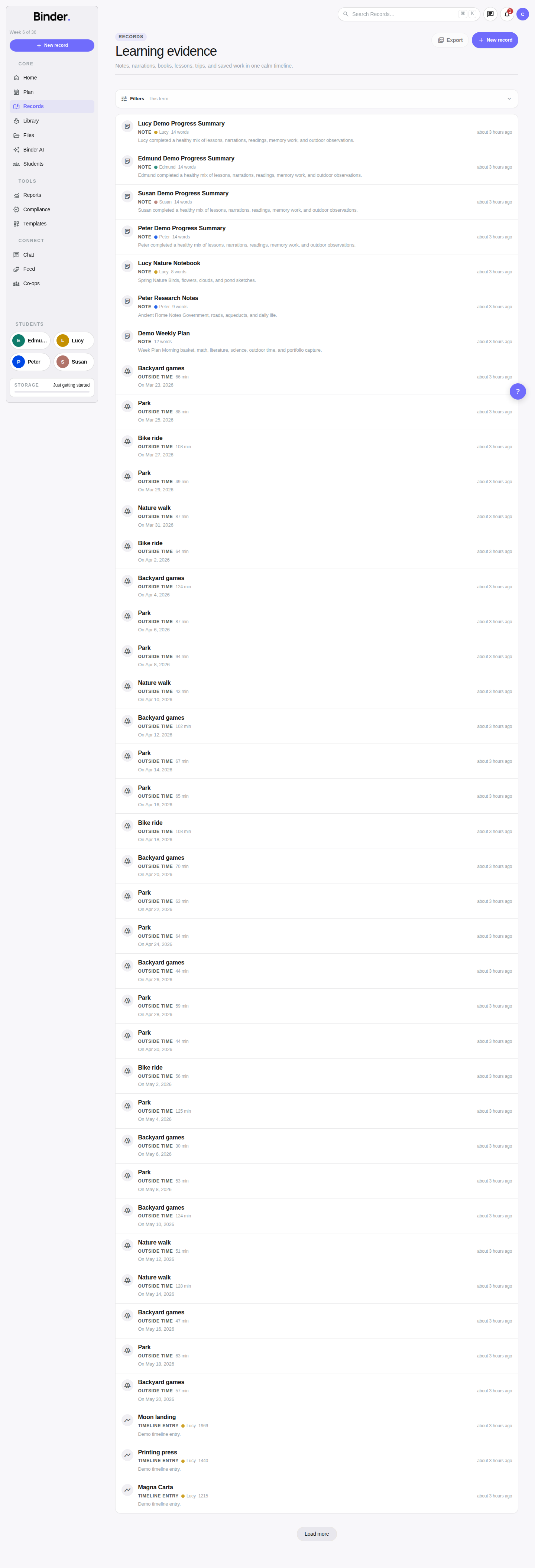
Binder does not lock you into one style. The method setting helps tailor language and suggestions, but every tool remains available when your plan needs to bend.
A simple first-month plan
If you are new, do not try to master every tool in one week. Start with the minimum useful loop.
Pick a six-week experiment
Choose one primary style and one backup style. For example: Charlotte Mason with traditional math, or Unit Studies with daily skill practice.
Add children, subjects, and a term
Set up the family basics in Binder. Use broad subject names at first; refine them after you see how your days actually work.
Plan only one week
Avoid planning the whole year before you have feedback. Schedule enough to start, then adjust next week.
Log the real day
Mark completed lessons, write a daily log, add books or field trips, and attach one or two pieces of evidence.
Review after Friday
Ask what felt peaceful, what felt forced, what your child remembered, and what you avoided because it was too complicated.
Make one change
Do not rebuild everything. Change one variable: lesson length, number of subjects, book choice, outside class, or recordkeeping rhythm.
Common beginner mistakes
Choosing a style as an identity
A style is a tool, not a personality test. Use the parts that help your family learn and document well.
Buying too much too early
Curriculum and materials can help, but overbuying adds pressure. Start lean, then buy for real needs.
Copying classroom time
One-on-one instruction is usually more efficient than classroom instruction. Shorter direct lessons can still be serious.
Not keeping records until later
Records are easiest when captured lightly as you go. Binder is built to turn small daily notes into useful long-term documentation.
Where to go next
Map styles to Binder features
The Homeschool methods guide explains which Binder tools fit each style and how to configure them.
Start the app setup
The Getting started guide walks through account setup, children, terms, subjects, and the first week plan.