Homeschool methods
Binder adapts to how your family teaches.
Choose a method during setup to shape the app's language, dashboard tools, and AI suggestions. You can mix and match features freely regardless of the method you choose — these guidelines are recommendations, not restrictions.
New to homeschool styles?
If the method names are still new, start with the beginner homeschool styles guide. It explains the major approaches in plain language, shows what a day can look like, and maps each style into Binder.
Method screenshots
Binder supports different homeschool philosophies by combining planning, daily tools, portfolio records, and reporting in flexible ways.
Charlotte Mason
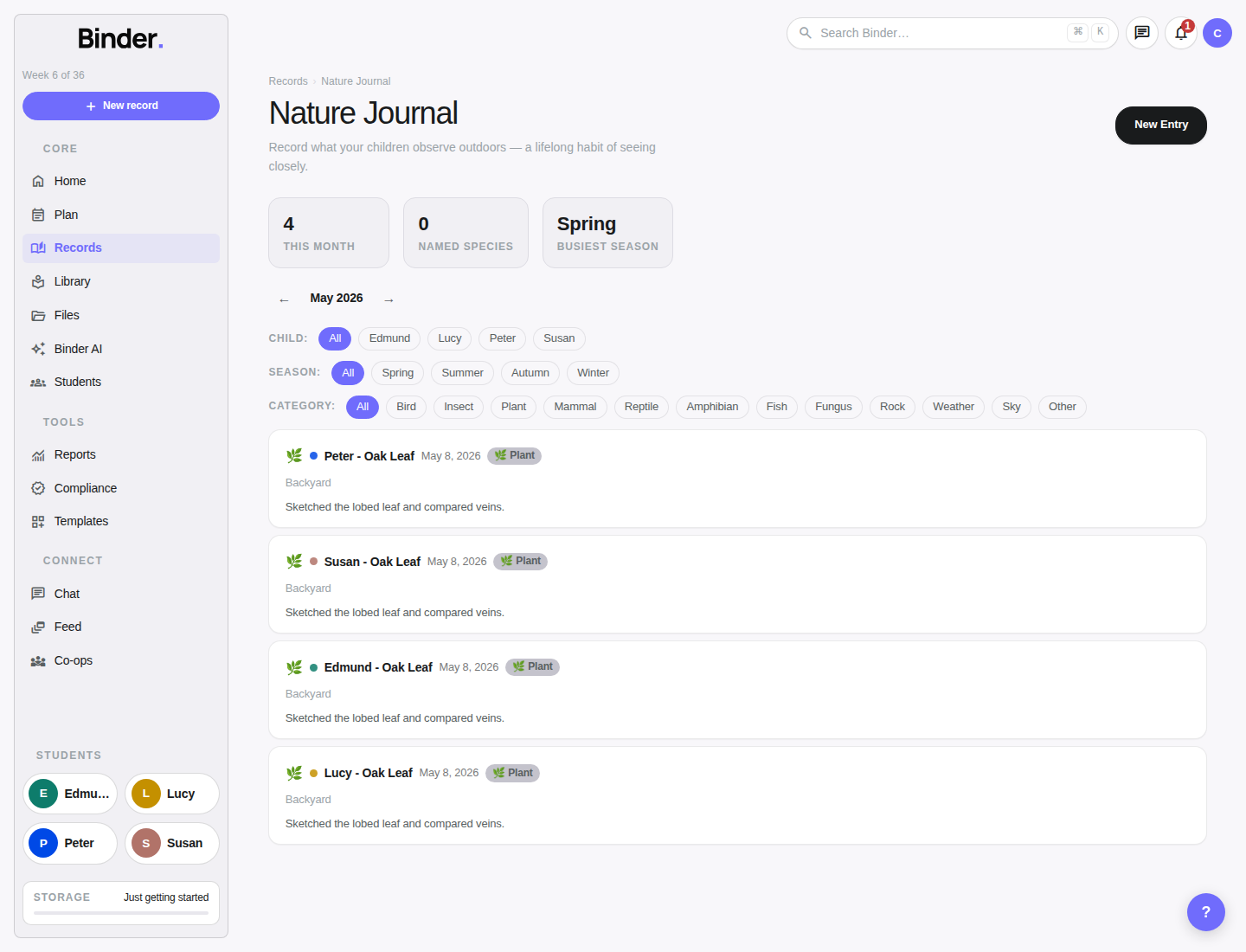
Charlotte Mason education centers on living books, narration, short lessons, nature study, habit training, and an atmosphere of ideas. Binder's most Mason-aligned tools are narrations, nature journal, copywork, artist/composer study, and the Book of Centuries (timeline).
Primary tools
- Narrations — Log oral and written narrations after every reading. Link them to the source book for a clear record.
- Nature Journal — Record species, observations, locations, and photos for each nature session.
- Copywork & Dictation — Track passages copied and mastered, with the source text and date for each entry.
- Artist & Composer Study — Manage artist rotations, mark individual works as studied, and build a multi-year cultural record.
- Habits — Track Charlotte Mason habit training (obedience, attention, truthfulness) without turning them into grades.
Tips
- Create subjects like "Nature Study," "Narration," "Copywork," and "Handicrafts" to match Mason's subject language.
- Keep lessons short in the planner — Mason recommended 15–20 minute lesson slots for younger children.
- Use the Book of Centuries (timeline entries) for a child's growing historical chronology.
- Log read-alouds for all living books read to multiple children simultaneously.
- The daily journal is ideal for capturing the richness of a Mason day that lesson check-offs alone won't cover.
Classical
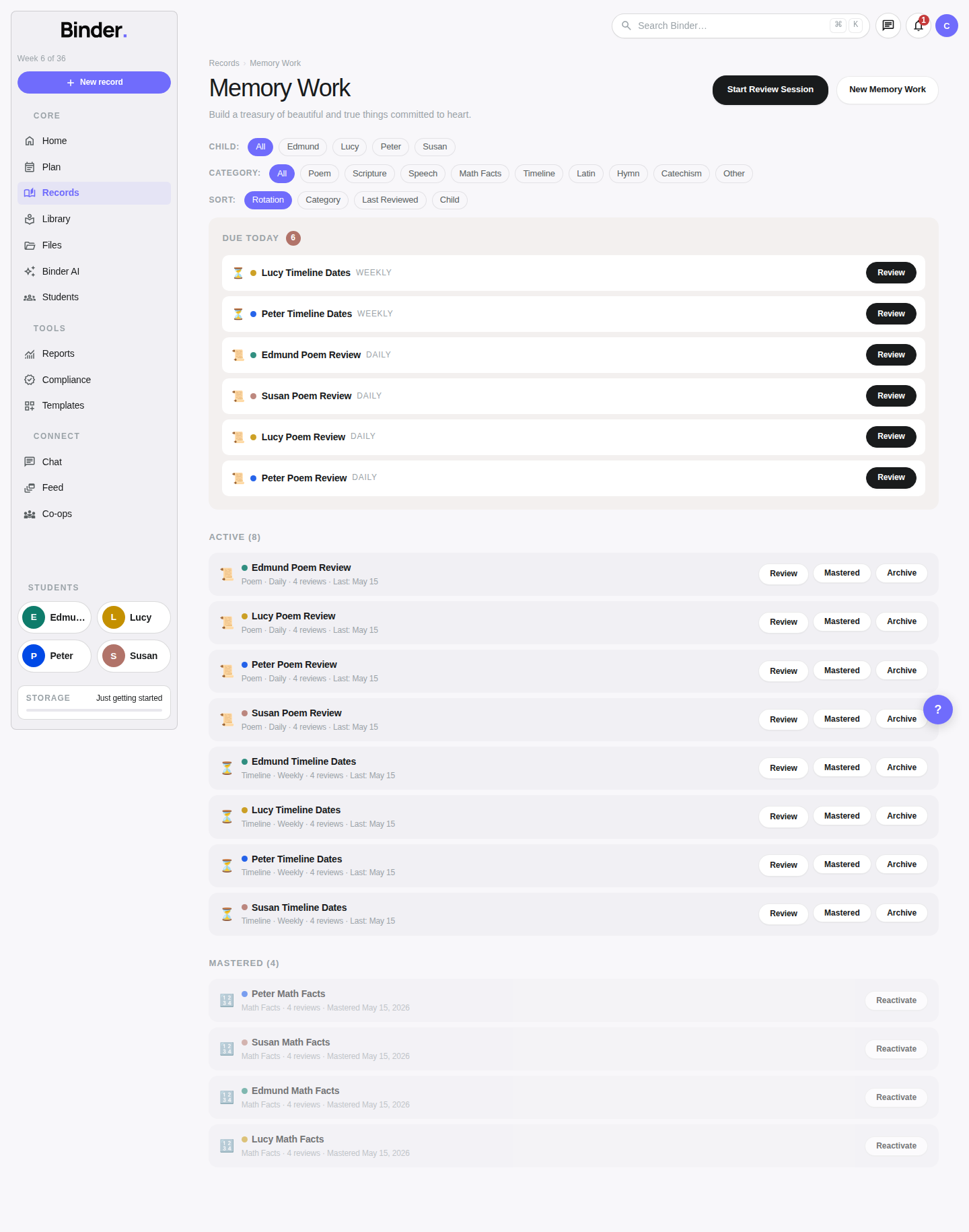
Classical education follows the medieval trivium — grammar, logic, rhetoric — typically mapped to developmental stages. It emphasizes memory work, great books, history cycles, and rigorous academics. Binder's memory work tool with spaced repetition is the most powerful feature for classical families.
Primary tools
- Memory Work — Enter Latin declensions, grammar rules, history facts, timeline events, and poetry. The spaced repetition algorithm schedules reviews based on your child's confidence so nothing is lost.
- Timeline — Use the Book of Centuries / timeline entries to build and maintain a visual historical chronology per child.
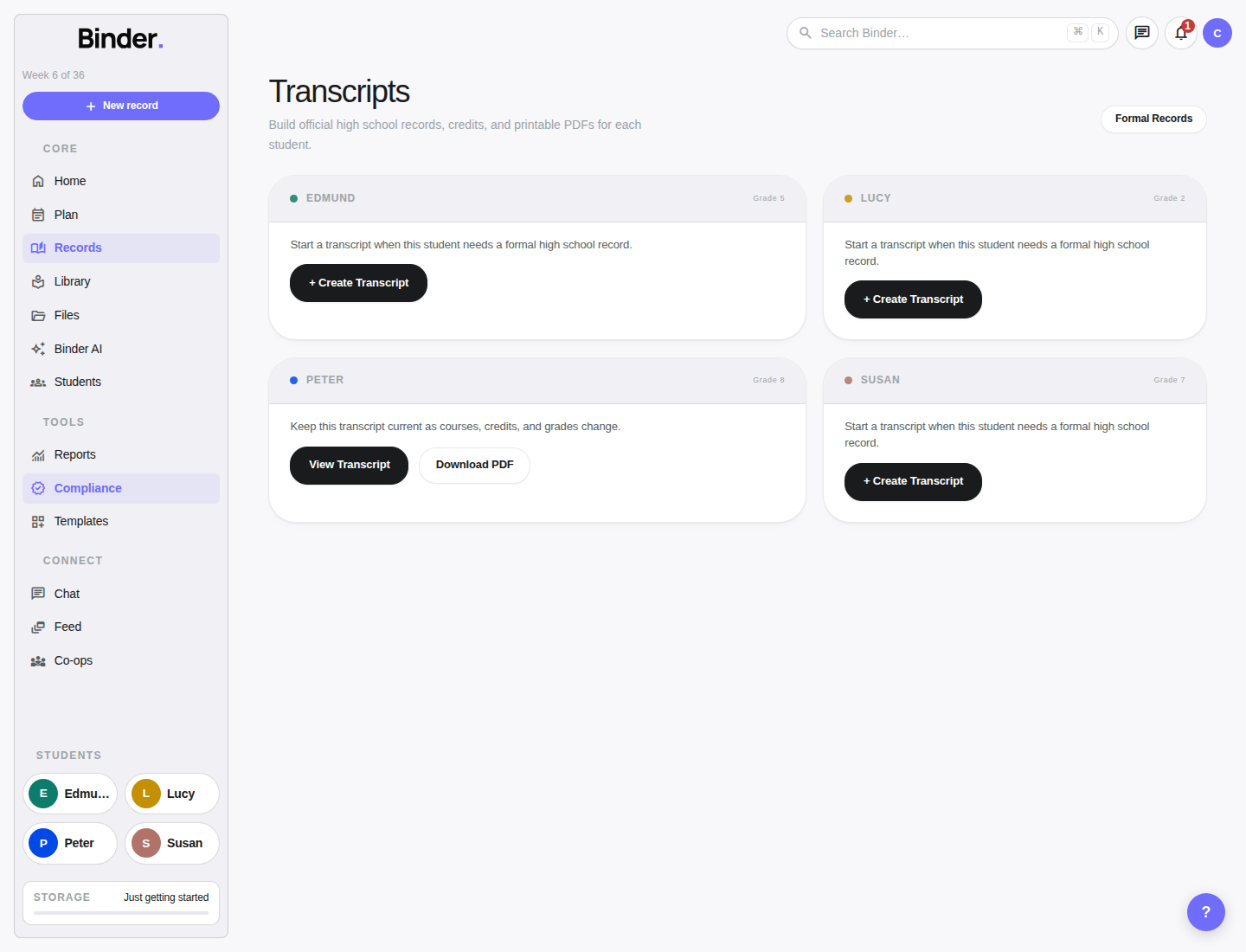
- Transcripts — Create high-school courses with credits, grades, and GPA for college preparation (Scholar plan).
- Records — Write formal annual narratives or portfolio records for each child using the rich-text editor.
Tips
- Tag history lessons with cycle numbers (Cycle 1, Cycle 2, Cycle 3) using subject colors to spot cycle coverage in reports.
- Use memory work categories: Latin, math facts, grammar, poetry, scripture to organize the review queue by type.
- For the logic and rhetoric stages, use the rich-text lesson notes for dialectic questions and rhetoric assignments.
- Start tracking high-school courses as formal transcript courses by 9th grade so credits are clean when graduation arrives.
Montessori
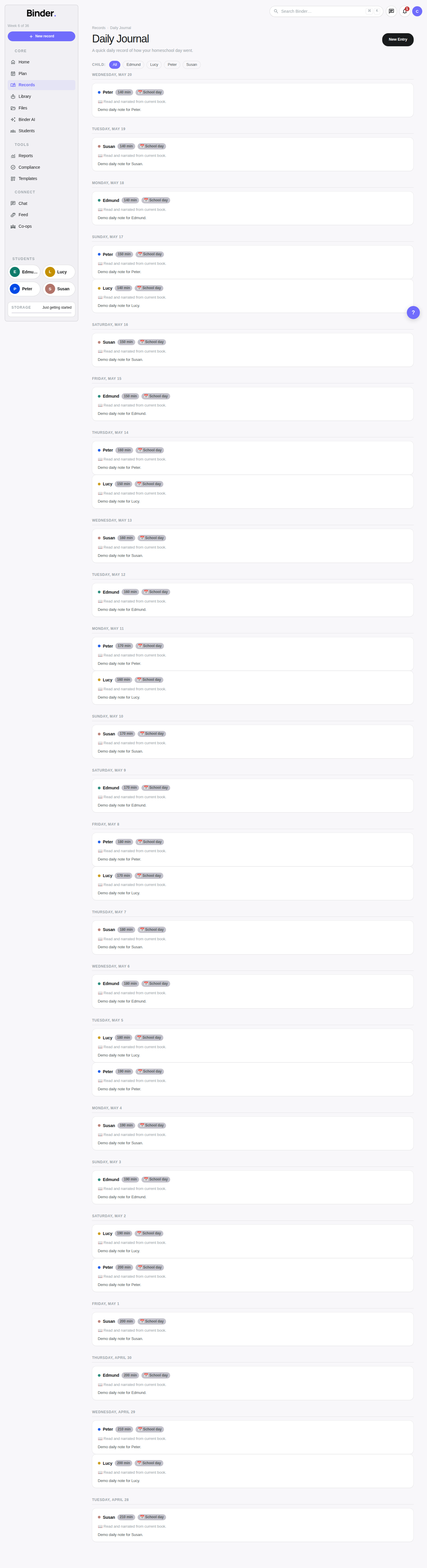
Montessori education is child-led, hands-on, and organized around developmental planes rather than grade levels. Records in Montessori are observation-based — what did the child choose, what did you observe, what materials were used. Binder's daily journal and narration tools are the natural fit for Montessori documentation.
Primary tools
- Daily Journal — Record what the child chose to work on, what you observed, which materials they used, and any breakthroughs or areas still developing.
- Trackers — Create custom grid trackers for developmental areas (practical life, sensorial, language, mathematics, cultural studies, arts). Mark each skill as introduced, developing, or mastered.
- Artifacts — Attach photos of in-progress work, completed projects, and material explorations directly to lessons or journal entries.
Tips
- Create subjects that map to Montessori areas: Practical Life, Sensorial, Language, Mathematics, Cultural Studies, Arts and Crafts.
- Use the tracker custom columns to log skill progression: "Text" columns for notes, "Checkbox" columns for mastery, "Date" columns for introduction dates.
- The portfolio feed with photo evidence is especially strong for Montessori documentation — evaluators and reviewers respond well to visual portfolios.
- Binder's grade level setting can be set to developmental stage rather than chronological age if that better reflects your work.
Waldorf
Waldorf education follows a developmental curriculum tied to the seasons, integrating arts, stories, movement, and main lesson block teaching. The main lesson book — a child-created illustrated record of each topic — is central to the Waldorf approach. Use Binder to plan blocks, log sessions, and build a photo-rich portfolio of main lesson work.
Primary tools
- Planner — Plan main lesson blocks as multi-week runs of the same subject for the same child. The week planner makes block scheduling visual.
- Artist & Composer Study — Integrate seasonal art study and seasonal music into your cultural study record.
- Nature Journal — Document seasonal nature observations, plant and animal cycles, and outdoor nature work.
- Artifacts — Photograph main lesson book pages, watercolor paintings, handwork projects, and seasonal displays as evidence of the term's learning.
Tips
- Use subject colors to distinguish block subjects. When a main lesson block ends, the color usage in reports clearly shows when each block ran.
- The daily journal is perfect for capturing the narrative of a Waldorf day — festivals, seasonal activities, story recapping, and circle time.
- Use lesson notes to record the story or verse used in each session as a reference for the main lesson book.
- Create a "Handwork" or "Crafts" subject to track eurythmy, knitting, woodwork, and seasonal crafts separately from academic block work.
Unschooling
Unschooling — child-led, interest-driven learning without a fixed curriculum — requires documentation that captures the real learning happening without a formal lesson structure. Binder is built to record this kind of learning without forcing it into an artificial school shape.
Primary tools
- Daily Journal — The primary record for unschooling families. Write a daily narrative of what the child engaged with, discovered, built, questioned, or explored.
- Field Trips — Log every museum visit, library trip, park exploration, community event, and educational outing. These are the curriculum for many unschooling families.
- Book List — Track books read independently. Many unschooled children read voraciously — a book list over the year tells a powerful story.
- Outside Time — Log outdoor hours if your state has a physical education or outdoor learning requirement.
Tips
- Create broad subjects like "Exploration," "Self-Directed," or "Interest-Led" to tag daily journal entries and field trips for compliance reporting.
- Use the daily journal generously — an unschooling year of rich daily journals is a compelling portfolio in itself.
- Attach photos and artifacts to field trips and daily journal entries. Visual evidence of real-world learning resonates with evaluators.
- The compliance profile shows how your logged days and hours compare to your state's requirements, even when the learning doesn't fit traditional categories.
Eclectic
Eclectic homeschooling mixes approaches and resources — a Charlotte Mason language arts block here, a traditional math curriculum there, co-op classes, online courses, and family-created projects. Binder handles eclectic families well because you're free to use any combination of tools without committing to one philosophy.
Recommended approach
- Use the planner for structured curriculum subjects (math, grammar, foreign language).
- Use narrations and nature journal for Charlotte Mason elements.
- Use memory work for classical elements like Latin vocabulary and timeline work.
- Use daily journal for unstructured or project-based days.
- Use field trips and outside time for experiential learning.
- Use the portfolio feed to see how all of it weaves together across the term.
Tips
- Create one subject per curriculum or major area. Eclectic families often have more subjects than other approaches.
- Use the lesson notes to record which curriculum resource you used for each lesson — this makes it easy to track progress through a textbook or program across weeks.
- Let the portfolio feed do the "proving" work. An eclectic year often looks more coherent from the outside than it feels from the inside.
Unit Studies
Unit studies organize all learning around a central topic — Ancient Egypt, ocean life, the American Revolution — integrating reading, writing, math, art, geography, history, and science through that topic's lens. Binder helps you plan unit blocks and map learning back to subjects for compliance.
Recommended approach
- Create a lesson for each day's unit activity, tagged with the relevant subject (a mummy-building project covers History, Science, and Art).
- Use lesson notes to record the books, resources, videos, or materials used in each session.
- Attach photos of projects, finished artwork, and experiments as evidence artifacts.
- Log field trips related to the unit — a museum visit for the Egypt unit, a tide pool trip for the ocean unit.
- Write a portfolio record at the end of each unit summarizing what was covered and what the child produced.
Tips
- Tag each lesson with multiple subjects if the activity spans disciplines. Binder lets you see subject-hour totals across the term so you can verify broad coverage.
- Use Curriculum Lists to build a reading list for each unit and keep it for your own reference across years.
- Use the planner's copy-week feature to extend a unit another week when something goes deeper than planned.
Traditional
Traditional homeschooling mirrors the structure of conventional school: set subjects, textbook-based curricula, graded assessments, attendance tracking, and formal records. Binder is well-suited to this approach — the planner handles weekly scheduling, the subjects system handles curriculum tracking, and the transcript tool handles high-school records.
Primary tools
- Planner — Schedule daily lessons by subject for each child. Set lesson durations to match your class periods.
- Subjects — Create one subject per course: Mathematics, English Language Arts, History, Science, Foreign Language, Physical Education, Elective.
- Attendance — Mark school days, holidays, and sick days. Track against the academic calendar and state requirements.
- Transcripts — For high school, create formal course records with credits, letter grades, semester/year, and course descriptions. Binder calculates weighted and unweighted GPA (Scholar plan).
- Progress Reports — Generate term-based progress reports with hours by subject for evaluator submission (Plus plan).
Tips
- Use lesson templates to schedule recurring class periods on specific weekdays — math every Mon/Wed/Fri, science every Tue/Thu.
- Log test grades and assessments as lesson notes or attach them as artifact evidence.
- Start the transcript tool in 9th grade even if you won't need it for years — establishing the record early avoids scrambling at graduation.
- Use the compliance profile to verify your day and hour counts against your state's requirements throughout the year, not only at year's end.